Computer Vision Exhibit Prototypes
Rapid R&D for Museum-Scale Gesture Interactives
HOME
DATESpring 2015
Executive Summary
Thinc Design commissioned Unified Field to prototype several high-risk interactive concepts for a proposed major exhibit package targeting the Cleveland Museum of Natural History. These concepts were being explored at the pitch / feasibility stage, where the goal was not polished UI, but to prove that ambitious interaction ideas could actually work in the real world.
The prototypes focused on solving a core museum challenge:
The prototypes focused on solving a core museum challenge:
How do you create intuitive gesture-driven experiences for large public spaces, while hiding sensors, supporting multiple visitors, and working within strict physical exhibit constraints?
Project Context
Thinc’s exhibit concepts relied on depth-camera interaction (Microsoft Kinect) in ways that pushed beyond typical skeleton tracking use cases. The museum environment imposed several constraints that made the problems unusually difficult:
- sensors could not be visually obvious (no “camera on a tripod”)
- interactions needed to work quickly for first-time visitors
- systems had to tolerate noise, occlusion, and inconsistent visitor behavior
- tracking had to work at awkward angles due to exhibit architecture
- the interaction had to feel magical, not technical
Prototype 1 — Fabric of Spacetime
Problem
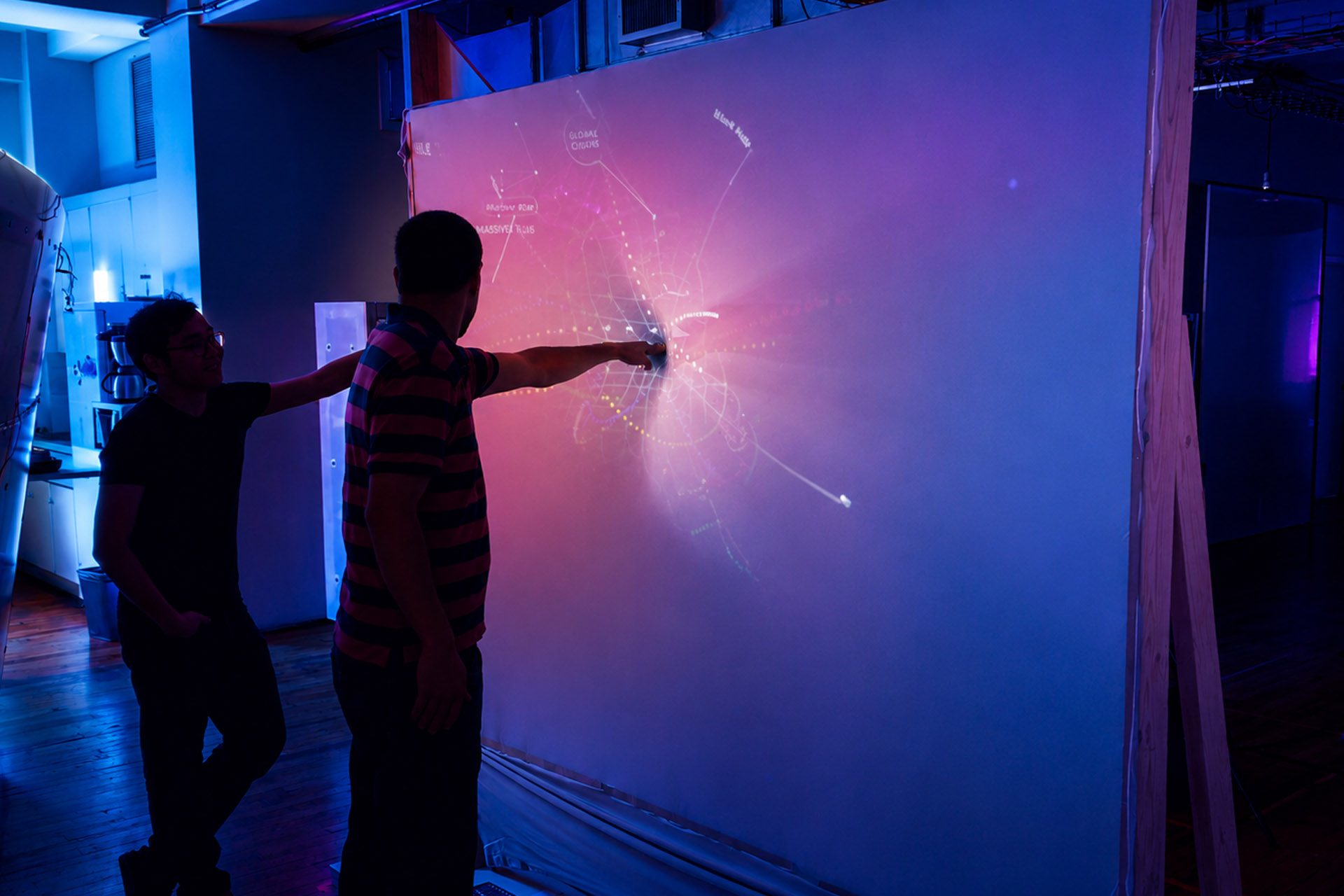
Thinc wanted visitors to physically push into a flexible rear-projection surface and see their input distort a projected “fabric of spacetime” in real time.
The core technical challenge was:
How do you measure depth and pressure across a large deformable surface, without installing visible sensors or mechanical hardware?
Approach
A large frame was built (approx. 6 ft wide) with a stretched Lycra-like fabric surface. A rear projector displayed a grid-based universe visualization, while a Kinect depth camera behind the fabric captured deformation depth.
To interpret input, I extended a CCV-based computer vision pipeline to support depth blob detection at multiple depth thresholds, allowing the system to detect:
- where a visitor was pressing
- how large the press region was
- how deep the surface was being displaced
Result
The prototype demonstrated that a large-scale tactile surface could be translated into stable multi-point interaction data, making the exhibit concept physically viable.
Prototype 2 — Grab a Star (Tabletop Kinect, Upward-Facing)
Problem
Thinc envisioned an exhibit where visitors could walk up, point at a massive starfield display, and “grab” a star from across the room.
But they insisted on a major constraint:
Sensors could not be visible, and the tracking hardware could not be positioned in the normal Kinect orientation.This meant the Kinect would be mounted low in the exhibit station, facing upward—essentially using it backwards.
The hard part wasn’t detecting a person. It was:
- determining which direction they were pointing
- inferring a target point on a distant screen
- supporting repeatable gestures that felt natural to visitors
Approach
I built an openFrameworks prototype using Kinect V2 depth data and OpenCV-based segmentation.
Instead of relying on skeleton tracking (which breaks at extreme angles), I treated the visitor’s arm as a depth silhouette and extracted a pointing vector by detecting:
- the arm’s entry point into the sensor’s view
- the furthest extended point (hand/wrist region)
- horizontal direction from entry → extension
- vertical direction inferred from relative depth between entry and extension
Result
The prototype successfully demonstrated pointing inference using depth-only geometry, even with the Kinect placed in an unconventional position.
Prototype 3 — Grab a Star (Ceiling Kinect, Downward-Facing Skeleton Tracking)
Problem
A second concept was to mount the Kinect in the ceiling, looking down at the visitor stations, keeping hardware completely hidden.
This was appealing architecturally, but created a major technical risk:
Kinect skeleton tracking is not designed to reliably interpret pointing gestures from a steep overhead angle, especially in crowded environments.
Approach
I built a second prototype attempting to use skeleton tracking under a near-overhead camera placement. A cursor system was implemented so the visitor could aim at targets projected across the room, then trigger selection by pulling their arm inward.
Result
This approach partially worked but exposed major limitations:
- skeleton tracking instability
- arm distortion when visitors stood too close or at odd angles
- frequent loss of tracking under real-world posture variation
What This Project Demonstrated
This case study is less about UI polish and more about engineering problem solving under constraints:
- rapid feasibility testing for high-risk exhibit concepts
- extending depth-camera blob detection beyond typical use cases
- gesture design that accounts for unreliable visitor behavior
- designing around sensor placement restrictions (hidden hardware)
- mapping 3D physical motion to 2D interaction targets at room scale
Tools & Technologies
- openFrameworks (C++)
- Microsoft Kinect V2
- OpenCV (depth image segmentation + blob analysis)
- CCV pipeline modification / extension
- Prototype collaboration with Flash simulation front-end (Fabric of Spacetime)
Deliverables
- three working interactive prototypes
- behind-the-scenes demonstration videos
- feasibility findings that helped inform design direction and sensor placement strategy